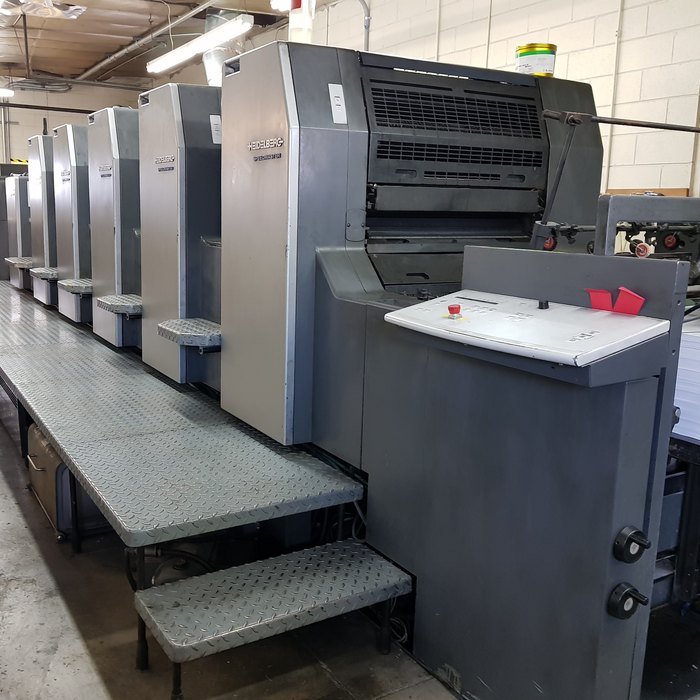
When Vishal Offset in Delhi outgrew their 1988 two-colour Heidelberg SORSZ, we supplied and fully installed a 1995 Heidelberg SM 102-4 — a four-colour, 28×40 press with Autoplate, CPC 1.03 ink control, cocking register and Alcolor dampening. The upgrade took them from running four-colour work in two passes to a single pass, with faster make-ready and tighter registration. Here is exactly how the changeover was planned, executed and installed.
Where Vishal Offset started: a 1988 two-colour SORSZ
Vishal Offset had built a solid commercial print business on a Heidelberg SORSZ — a dependable 28×40 (72×102 cm) two-colour workhorse from 1988. It printed clean, reliable work for years, which is exactly why so many Delhi print shops still trust the older Heidelberg platforms. But as their jobs shifted towards more four-colour process work — brochures, cartons, multi-colour publicity — the two-colour format started to hold them back.
On a two-colour press, a four-colour job means two passes through the machine: print two colours, let the sheet dry or back-trip, then run it again for the other two. That doubles make-ready, doubles the chance of a registration mismatch between passes, and roughly halves throughput on colour work. For a shop trying to take on more process jobs, the maths stops adding up.
Why the move to a four-colour Heidelberg SM 102-4
The obvious answer to “we do too many four-colour jobs in two passes” is a four-colour press — but the right machine matters. Vishal Offset wanted to stay on the Heidelberg platform they already knew, keep the same 28×40 sheet size so their existing work and dies carried over, and get the productivity features that make four-colour printing genuinely fast, not just possible.
We matched them to a 1995 Heidelberg Speedmaster SM 102-4 from our own stock — the same 28×40 format, four printing units, and a specification chosen for exactly this kind of upgrade.
Old press vs new press at a glance
| Feature | Old — Heidelberg SORSZ | New — Heidelberg SM 102-4 |
|---|---|---|
| Year | 1988 | 1995 |
| Colours / units | 2 | 4 |
| Max sheet size | 28 × 40 in (72 × 102 cm) | 28 × 40 in (72 × 102 cm) |
| Four-colour job | Two passes | Single pass |
| Plate changing | Manual | Autoplate (semi-automatic) |
| Ink & register control | At the press, by hand | CPC 1.03 remote console |
| Registration | Standard | + Cocking (diagonal) register |
| Dampening | Conventional | Alcolor continuous |
The features that made the difference
Two four-colour presses of the same age can perform very differently depending on their equipment. These are the four features on this SM 102-4 that directly changed how Vishal Offset works day to day.
Autoplate — faster make-ready
Changing four plates by hand on every job is where a lot of press time quietly disappears. Autoplate semi-automates plate changing across all four units, cutting make-ready time significantly. On a shop running many short-to-medium four-colour runs, that recovered time is real capacity — more jobs off the same shift.
CPC 1.03 — ink and register from a remote console
Heidelberg’s CPC (Computer Print Control) 1.03 lets the operator set ink keys and register from a console rather than adjusting each unit by hand at the press. That means faster colour matching, more consistent ink across the run, and stored settings for repeat jobs — a big quality-and-speed jump over hand-setting a two-colour press twice per four-colour job.
Cocking register — for tight two-sided work
The press is fitted with cocking (diagonal) register, which lets the operator correct skew by cocking a unit slightly. This is what you need for accurate two-sided cross registration — getting the front and back of a sheet to line up precisely — which matters on booklets, forms and any back-to-back colour work. It is one of those features you do not miss until a job demands it.
Alcolor dampening — stable water balance
Alcolor is Heidelberg’s continuous (alcohol) dampening system. It holds a steadier water balance across the run, which means cleaner solids, fewer scumming or drying issues, and more consistent colour from the first good sheet to the last — a noticeable step up from conventional dampening on demanding four-colour jobs.
How we handled the complete installation
Supplying the right press is only half the job — a large-format Heidelberg has to be moved, rigged and commissioned correctly, or all those features are worth nothing. For Vishal Offset we handled the complete installation end to end:
- Inspection and testing of the SM 102-4 at our own godown before dispatch, so there were no surprises on site.
- Dismantling, rigging and transport to their Delhi premises, and safe positioning of each unit.
- Electrical connection and levelling, then reassembly and alignment of the printing units, feeder and delivery.
- Commissioning the CPC console, Autoplate and Alcolor dampening, and running test forms to confirm registration and colour.
- Hand-over and operator familiarisation so their team was productive on the new press quickly.
Because we managed the whole move ourselves, Vishal Offset had a single point of responsibility from the godown to the first live job — not a machine dropped at the door.
The result
Vishal Offset now runs their four-colour work in a single pass instead of two, with faster make-ready from Autoplate, consistent colour from CPC and Alcolor, and the registration accuracy to take on tighter two-sided jobs. The 28×40 format meant their existing work carried straight over — this was an upgrade in capability, not a disruption to their business. It is a textbook example of moving up the Heidelberg range at the right time, with the right specification.
Thinking about a similar upgrade?
If you are running a two-colour press and turning away — or double-passing — four-colour work, a well-specified used four-colour Heidelberg is often the most cost-effective way to step up. We hold inspected stock at our Delhi NCR godown and handle installation ourselves. Browse our used Heidelberg offset printing machines, see all machines in stock, or contact us for advice on the right press and a fair exchange value for your current one. You can learn more about the Speedmaster platform on Heidelberg’s official site.
Frequently Asked Questions
What is a Heidelberg SM 102-4?
The Heidelberg Speedmaster SM 102-4 is a four-colour sheetfed offset press with a 28×40 inch (72×102 cm) maximum sheet size. It prints all four process colours in a single pass and is a popular upgrade for shops moving on from two-colour presses.
Why upgrade from a two-colour SORSZ to a four-colour press?
A two-colour press has to run a four-colour job in two passes, which doubles make-ready and raises the risk of registration errors between passes. A four-colour press does the same job in one pass, roughly doubling colour throughput and improving consistency.
What do Autoplate, CPC, cocking register and Alcolor do?
Autoplate speeds up plate changing; CPC (Computer Print Control) sets ink and register from a remote console for faster, more consistent colour; cocking register corrects skew for accurate two-sided work; and Alcolor continuous dampening holds a stable water balance for cleaner, more consistent printing.
Do you handle installation of the machines you sell?
Yes. As with Vishal Offset in Delhi, we handle the complete process — inspection, dismantling, transport, positioning, electrical connection, commissioning and operator hand-over — so the press is production-ready.
Info